
The AI productivity market has produced an enormous number of tools that tell you things. They summarize your emails. They transcribe your meetings. They alert you to deadlines and flag overdue tasks. They generate dashboards and reports. They are, in the language of operational management, excellent at producing awareness — and almost entirely unable to drive action.
An AI operative assistant is a different category of tool. It does not just inform. It executes. Or more precisely, it drives execution: assigning work, tracking progress, surfacing blockers, closing loops, and learning from the patterns that emerge. The distinction is not cosmetic — it represents a fundamental shift in what AI is actually doing for your team.
Awareness Without Action Is Expensive
Every alert that gets acknowledged and then forgotten represents a failure of the tool, not the user. Every summary that is read and then lost in the inbox is waste, not progress. The productivity industry has spent fifteen years building tools that create awareness — and organizations are drowning in it.
The problem with awareness-only tools is that they add to the cognitive load of the humans reading them without reducing the actual work that needs to be done. A notification that a task is overdue does not complete the task. A meeting summary that lists action items does not ensure those items get assigned. These tools are useful — but they stop short of the point where they would actually change outcomes.
What “Operative” Means
The word “operative” is deliberately chosen. An operative is not an advisor — they act. In the context of an AI operative assistant, this means the system is responsible not just for surfacing information but for driving work forward through the full cycle from identification to completion.
This requires several capabilities that awareness tools lack: the ability to assign work to the right person without human prompting, the ability to follow up on that assignment proactively, the ability to escalate when progress stalls, and the ability to recognize when a task has been genuinely completed versus administratively closed.

Wincent as Operative Layer
Wincent is built explicitly as an operative layer, not an awareness layer. Its architecture reflects this distinction at every stage. The Input stage is not designed to produce a summary — it is designed to feed the Judgement stage with structured operational data. The Judgement stage is not designed to produce a report — it is designed to drive the Execution stage with clear assignments and ownership. The Execution stage is not designed to track tasks passively — it is designed to chase them actively.
This is what Wincent describes as the AI Chief of Staff function: not a reporting tool, not a note-taker, but an operational agent that holds the execution thread and drives work forward without waiting to be asked. The coaching layer that closes Wincent’s loop adds a further dimension: learning from execution patterns to surface systemic improvements, not just individual task completions.
The Integration Requirement
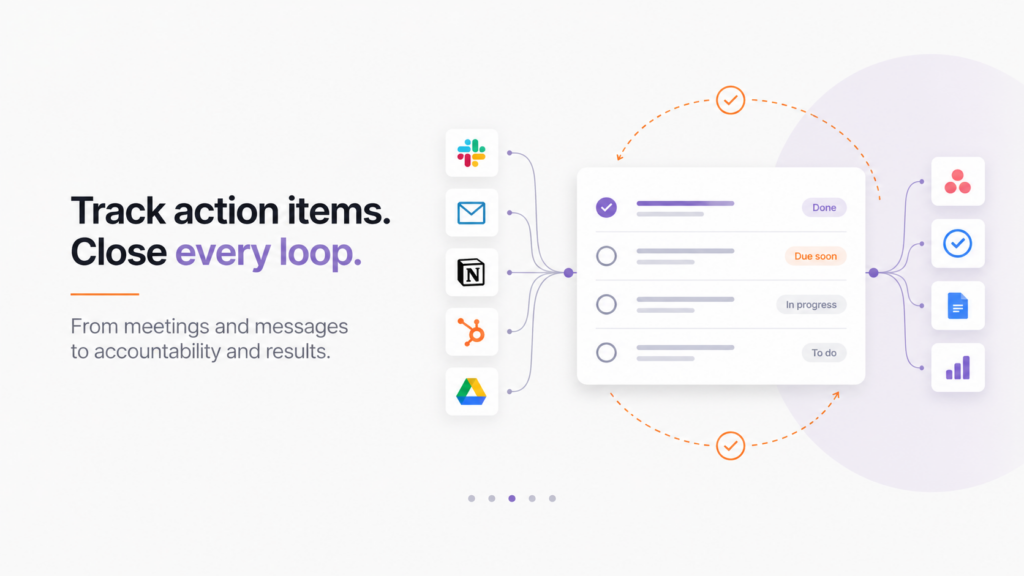
An AI operative assistant cannot drive execution if it can only see part of the operational context. Wincent integrates with Microsoft 365, Google Workspace, Slack, Notion, HubSpot and more — providing visibility across the full stack of tools where decisions are made and work is tracked. Without this breadth, an operative AI is forced to make decisions on partial information, which leads to mis-assignments, missed context, and eventually a loss of team trust.
Conclusion
The next evolution of AI productivity tools is not smarter alerts or richer summaries. It is AI that actually moves work forward — that closes the loop between what needs to happen and what actually gets done.
Wincent represents this category: an AI operative assistant that treats execution as its primary function, not a byproduct. For teams that are tired of being informed about problems and ready to be helped solving them, this is the architecture that matters.