
Task ownership is the single most important variable in whether work gets done. More than priority. More than deadline. More than how clearly the task is defined. If nobody is unambiguously responsible, the probability of completion drops dramatically — regardless of how well everything else is structured.
Automated task ownership is the process by which an AI system assigns responsibility for work items without requiring a human to make that decision explicitly. It sounds straightforward. In practice, it is one of the most technically and organizationally challenging problems in the AI productivity space.
Why Ownership Is Hard to Automate
Ownership decisions require context that most task management tools do not have. Who owns this task? The answer depends on: the organizational structure, the specific skills required, who made the original commitment, whose workload has capacity, and what related tasks the person is already handling. No keyword or template can capture this complexity.
Early attempts at automated task creation — “smart” meeting notes that generate bullet-pointed action items — sidestep the ownership problem entirely. They surface the tasks but leave ownership to whoever happens to be reading the summary. This is better than nothing, but it does not eliminate the gap.
The AI Judgement Problem
Genuine automated task ownership requires AI that can read commitment signals from natural language, infer the most appropriate owner from context and organizational structure, distinguish between firm commitments and conversational filler, and handle the ambiguous cases — shared ownership, conditional tasks, tasks with no clear owner — without generating so much friction that humans stop trusting the system.
This is the judgement problem. And it is why most tools either over-assign (creating noise) or under-assign (creating gaps). Getting this right requires a model trained specifically on the patterns of how teams make and break commitments — not a general-purpose language model applied to a new domain.
How Wincent Approaches Automated Assignment
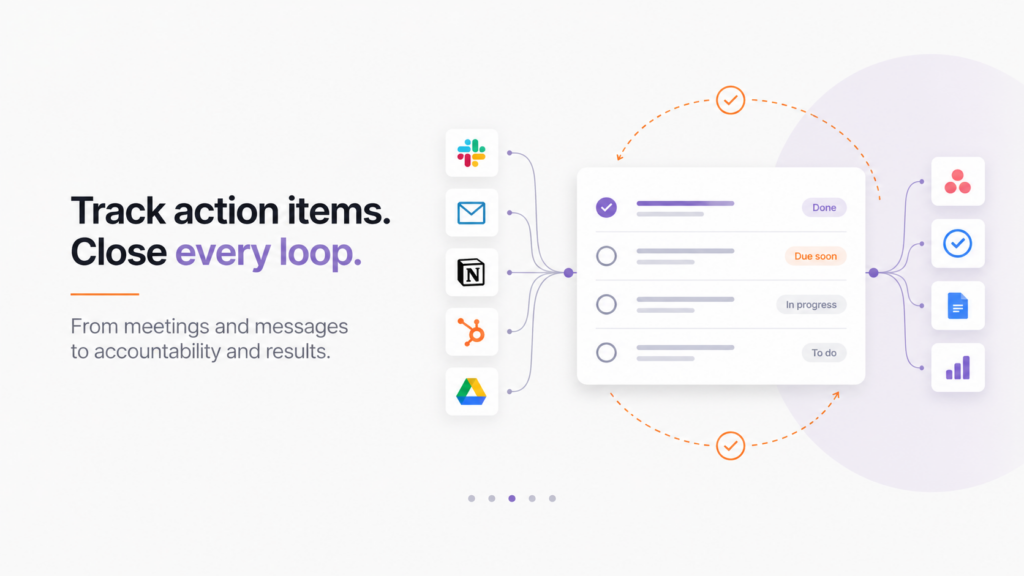
Wincent addresses the judgement problem by combining broad input coverage with a structured ownership framework. When a commitment is detected — whether in a meeting, an email, a Slack thread, or a shared document — Wincent evaluates multiple signals before assigning ownership: who spoke the commitment, whose work domain it falls within, what the team’s current workload looks like, and whether any similar tasks are already assigned.
The result is an assignment that reflects how a thoughtful human Chief of Staff would handle it — not a mechanical keyword match. Wincent also surfaces its reasoning transparently, allowing teams to correct assignments in cases where context makes the AI’s judgment suboptimal. Over time, these corrections inform the system’s future decisions.

Ownership Without Overload
One practical concern with automated assignment is overload: if the system assigns everything it detects to the most obvious person, that person will quickly be buried under tasks they did not agree to. This is not accountability — it is task dumping.
Wincent’s model avoids this by treating assignment as a starting point for a conversation, not a final mandate. Assigned items are visible to both the assignee and the relevant stakeholders. Workload signals are factored into the assignment logic. And humans retain the authority to reassign, defer, or close items — with the system learning from each decision.
Conclusion
Automated task ownership is not about removing human judgment from the process — it is about removing the ambiguity that causes human judgment to fail. When ownership is unclear, good people with good intentions drop work. When ownership is automatically assigned and transparently visible, that ambiguity disappears.
Wincent’s approach to automated assignment is a direct answer to this problem: AI that assigns responsibility contextually, transparently, and with enough intelligence to know when a case needs human review. The result is accountability infrastructure that scales with the organization, not just with the headcount.