Every organization has the same problem. Decisions get made in meetings, commitments get buried in email threads, and follow-ups disappear into chat history. Weeks later, nobody remembers what was agreed, who owns what, or whether it ever got done. This is not a human failure — it is a systems failure. And it is costing businesses more than they realize.
The answer is not another project management tool. It is not another meeting summary bot. The answer is a fundamentally different architecture: an AI closed loop task system — one that captures work at the point of origin, turns it into accountable action, and monitors execution through to completion. This article explains what that means, why it matters, and how platforms like Wincent are building it.
The Execution Gap: Where Work Goes to Die
Research consistently shows that the average knowledge worker spends between 20 and 30 percent of their working week recreating information that already exists somewhere in their organization. The problem is not that teams lack tools. The problem is that the tools do not talk to each other, decisions do not automatically become tasks, and tasks do not automatically generate accountability.
Consider a typical week. A leadership team holds a strategy call on Monday. Three decisions get made, but they live only in someone’s notes. On Wednesday, a customer email arrives requesting a follow-up that links directly to one of those decisions — but the person handling the email does not know the decision was made. By Friday, the team is in another meeting re-discussing what was already agreed on Monday.
This is the execution gap. Work stalls between tools, meetings, and inboxes. Nobody owns the gap — until now.
What Is an AI Closed Loop Task System?
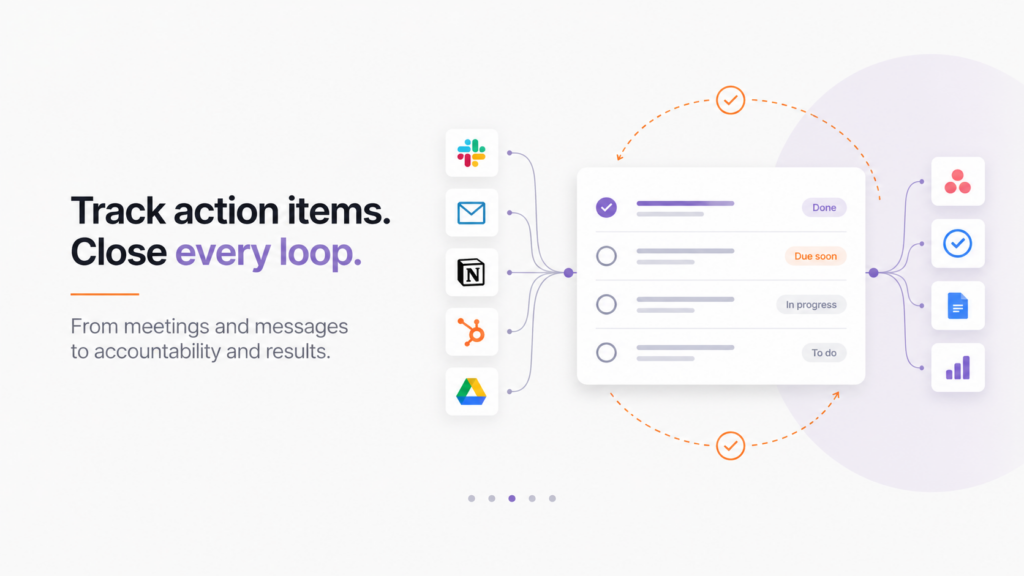
A closed loop task system is an end-to-end operational workflow where no input falls through the cracks. Unlike traditional project management tools — which require humans to manually transcribe decisions into tasks, assign owners, and chase updates — a closed loop system handles this automatically.
The “loop” has four critical stages:
1. Capture — the system ingests information from wherever work happens: meetings, emails, chats, documents.
2. Identify — AI reads that information and surfaces decisions, commitments, and ownership gaps.
3. Execute — those decisions become tracked tasks with assigned owners and automated follow-up.
4. Learn — the system observes patterns over time, surfaces recurring bottlenecks, and helps teams improve their operational rhythm.
The loop is closed when every piece of work that enters the system is either completed, explicitly deprioritized, or escalated — with full visibility at every stage. Nothing gets lost. Nothing gets forgotten. The system holds the institutional memory that no individual human can.
Why Existing Tools Fail to Close the Loop
It is worth being specific about why the current stack fails, because the diagnosis shapes the solution.
Meeting transcription tools capture what was said — but they do not turn it into structured, assignable work. They produce a searchable record, not an operational output.
Project management tools like Asana, Monday.com, or Notion are excellent at tracking work — but only the work that humans remember to enter. They are passive. They wait. And in fast-moving organizations, the gap between what happens and what gets logged is enormous.
AI productivity assistants like Copilot or Gemini summarize and generate — but they sit inside individual apps. They do not span across your entire operational context. They cannot see that a decision made in a Slack message is connected to an unresolved task in your CRM.
None of these tools close the loop. They each handle one stage well and leave the rest to chance — or to the mental overhead of an already-overstretched team.
How Wincent Closes the Loop
Wincent is built from the ground up as a closed loop operational system. It does not try to replace your existing tools — it connects across them and acts as the intelligence layer that no single tool provides.
Wincent integrates with Microsoft 365, Google Workspace, Slack, Notion, HubSpot and many more — capturing the full scope of where decisions, communications, and commitments actually live. This cross-platform capture is the prerequisite for everything that follows.
Stage 1: Input — Meeting to System in Real Time
Wincent’s input layer ingests information from across your operational stack — meeting notes, email threads, Slack conversations, shared documents, and CRM updates. The goal is not to archive this information but to make it immediately actionable.
For teams that live in Microsoft 365 or Google Workspace, this means decisions made in a Teams call or Gmail thread do not need to be manually transcribed. Wincent reads them in context and prepares them for the next stage.
Stage 2: Judgement — Identifying What Actually Matters
This is where Wincent is distinctly different from a transcription or summarization tool. Rather than delivering a raw summary and leaving interpretation to the human, Wincent applies AI judgement to determine what decisions were made, what ownership gaps exist, and what commitments were implied but not formalized.
This is a qualitatively harder problem than summarization. Deciding that “we should revisit the pricing model” is a decision with an implied owner and a follow-up action — but it rarely gets treated as one. Wincent’s judgement layer flags it, structures it, and prepares it for execution.
Stage 3: Execution — Turning Decisions Into Tracked Work
Once a decision or commitment has been identified, Wincent converts it into a tracked task with an owner, a deadline, and automated follow-up. The critical feature here is proactive chasing: Wincent does not wait for humans to remember to check in. It monitors progress and surfaces blockers before they become crises.
This is the function traditionally reserved for a Chief of Staff or a highly organized EA: someone whose job is to hold the operational thread and make sure nothing gets dropped. Wincent makes that function available to any team, at any size, without headcount.
Stage 4: Coaching — Learning From the Pattern of Work
The fourth stage is what separates a closed loop system from a task tracker. Over time, Wincent accumulates data about how your team operates: which types of decisions consistently stall, which owners consistently miss deadlines, which meeting formats generate the most actionable output.
This coaching layer turns operational data into organizational intelligence. Instead of just recording what happened, Wincent helps teams understand why it happened and how to improve. That is the difference between a tool and a system — and it is the difference between closing a loop once and closing it consistently.

Who Needs an AI Closed Loop Task System?
The organizations that suffer most from the execution gap share a few characteristics: they move fast, they make decisions in unstructured formats (calls, chats, informal meetings), and they have grown past the point where a single person can hold the operational context in their head.
In practice, this means scaling startups and growth-stage companies are the primary beneficiaries. At these stages, the founding team’s informal coordination habits start to break down. The CEO can no longer be in every thread. The COO cannot catch every decision. And there is no budget — or desire — to hire a Chief of Staff for every function.
But the problem is not limited to startups. Established mid-market companies with complex cross-functional workflows — product, sales, operations, customer success all moving in parallel — face exactly the same dynamic. The execution gap scales with organizational complexity.
The specific roles who feel this most acutely are founders and C-level executives who need operational clarity without operational overhead, operations and project managers responsible for cross-functional coordination, and sales and customer success teams where commitments made in calls need to reliably convert into follow-through.
The Case Against Point Solutions — and for a Single Operational Layer
The natural response to the execution gap is to add more tools. Another integration. Another automation. Another layer on top of an already fragmented stack. This instinct is understandable, but it is usually counterproductive.
Every new tool creates a new context switch. Every new integration requires maintenance. And critically, every point solution only solves one part of the loop — which means the gaps between tools remain exactly as wide as they were before.
The architectural insight behind Wincent is that the execution gap is not a problem that can be solved by any single tool. It is a coordination failure that lives between tools. Solving it requires a dedicated intelligence layer — one that reads across the entire stack, makes sense of what it sees, and drives action without requiring humans to manually bridge the gaps.
This is what Wincent describes as functioning like an AI Chief of Staff: not replacing any specific tool, but providing the operational awareness and follow-through that no individual tool currently delivers.
Key Features to Look For in an AI Task Tracking System
If you are evaluating AI-powered task management or closed loop systems, these are the capabilities that separate genuine solutions from glorified note-taking tools:
Cross-platform capture — the system must ingest from all the places where real work happens, not just the places where work is supposed to be documented. If it only reads your project management tool, it misses everything that happens before that.
Decision and commitment detection — the AI needs to distinguish between a discussion, a decision, and an implied commitment. This is a linguistic and contextual challenge that most general-purpose AI tools do not solve.
Ownership assignment — every tracked item needs a named owner and a clear deadline. Systems that create tasks without owners simply shift the accountability problem rather than solving it.
Proactive follow-up — the system should chase progress automatically, not wait for a human to remember to check. This is the most operationally valuable feature, and it is also the rarest.
Pattern recognition over time — a system that only works on individual tasks is useful. A system that surfaces trends and bottlenecks across weeks and months of organizational behavior is transformational.
The Future of Work Is Closed Loop
The shift toward AI-powered operations is not primarily about doing existing tasks faster. It is about closing the loops that have always been open — the decisions that never became actions, the commitments that never became deliverables, the patterns that were never visible until it was too late.
Organizations that build this capability now will have a structural advantage over those that continue to rely on human memory and informal coordination. Not because AI replaces human judgment — it does not — but because AI can hold the operational thread consistently in a way that no individual human, however talented, sustainably can.
Wincent’s bet is that this capability — the AI Chief of Staff function — will become as fundamental to organizational infrastructure as email or CRM within the next few years. The teams adopting it now are not experimenting with a novelty. They are building the operational muscle that will define their execution capacity as they scale.
Conclusion
An AI closed loop task system is not a feature improvement. It is an architectural shift in how organizations operate — from scattered, tool-dependent workflows to a unified intelligence layer that tracks everything from meeting to done.
The execution gap is real, expensive, and stubbornly persistent — because it lives in the spaces between tools that no single tool is designed to address. Platforms like Wincent are building the infrastructure to close that gap: capturing decisions wherever they happen, turning them into accountable action, and learning from the patterns that emerge over time.
If your team is losing work between meetings, inboxes, and tools — the answer is not another standalone app. It is a system that closes the loop, end to end, from the moment a decision is made to the moment it is done.