
The Chief of Staff is one of the most misunderstood roles in organizational life. In popular imagination, it is a kind of glorified assistant — someone who manages the calendar, handles logistics, and runs interference for a busy executive. In reality, the best Chiefs of Staff are operational architects: they hold the thread of the organization’s decision-making, ensure that commitments become actions, surface the information that leaders need before they know to ask for it, and maintain the institutional memory that keeps a fast-moving organization from repeating its own mistakes.
When Wincent describes itself as an AI Chief of Staff, it is the second definition that matters. And understanding exactly what that means — and what it does not mean — is essential for any team evaluating whether this category of tool is right for them.
What a Real Chief of Staff Does
The core function of an effective Chief of Staff is operational continuity. They ensure that what gets decided in a leadership meeting becomes what gets executed in the organization. They connect the threads between different functions and workstreams. They maintain the accountability infrastructure that keeps ambitious teams honest about their commitments.
In practice, this involves a set of activities that are mostly invisible until they stop happening: capturing decisions and converting them into tracked actions, monitoring execution across functions, surfacing blockers before they become crises, maintaining a living picture of the organization’s priorities and their status, and identifying the systemic patterns that slow things down.
A great Chief of Staff also provides something more subtle: the institutional memory that allows a fast-moving organization to learn from its own history. They remember what was tried before, what worked, and what failed. They connect current decisions to past context. They prevent the organization from reinventing wheels it has already broken.
What an AI Chief of Staff Can Do
Wincent’s AI Chief of Staff capability is designed to automate the operational continuity function — the parts of the Chief of Staff role that are powerful but mechanical enough to be systematized.
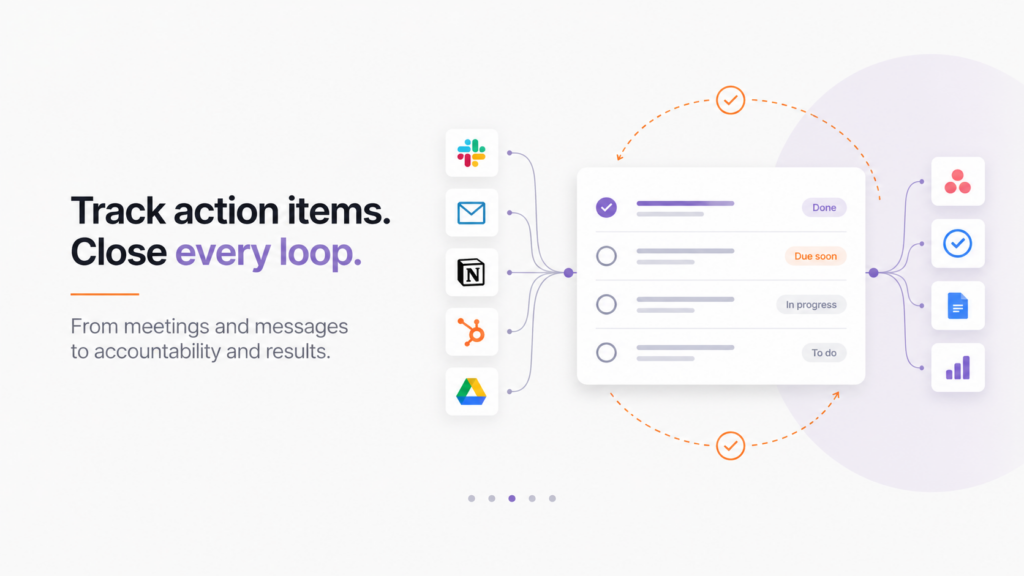
Concretely: Wincent captures decisions from meetings, emails, Slack threads, and documents across Microsoft 365, Google Workspace, Notion, and HubSpot. It applies AI judgement to identify what decisions were made, who owns the follow-up, and what the appropriate next steps are. It converts those decisions into tracked tasks with named owners and automated follow-up. And it builds a pattern of organizational behavior over time — surfacing where teams consistently stall, which types of commitments tend to slip, and where coordination breakdowns are structural rather than individual.
This is the core of the Chief of Staff function, translated into a system that operates continuously, across all the places where work happens, without requiring dedicated headcount.

What an AI Chief of Staff Cannot Do
Honesty matters here. An AI Chief of Staff cannot replace the relationship capital, political judgment, and executive presence that make a great human Chief of Staff transformationally valuable. These capabilities — knowing when to push back on a CEO, navigating board dynamics, managing sensitive personnel situations, building trust across an executive team — require human judgment and human relationship in a way that current AI simply cannot replicate.
Wincent does not pretend otherwise. The “AI Chief of Staff” framing describes a specific operational function — the execution continuity and accountability infrastructure that the role provides — not the full complexity of what a senior, strategic Chief of Staff brings to an organization.
This distinction matters for how teams should think about deploying Wincent. It is not a substitute for strategic leadership. It is infrastructure that makes strategic leadership more effective — by ensuring that the decisions leaders make actually get executed, and that the patterns of execution are visible rather than hidden.
Who Benefits Most
The organizations that benefit most from an AI Chief of Staff tool are those that are operating too fast for informal coordination to hold, but are not yet at the scale where dedicated operational headcount is justified or available. Scaling startups, growth-stage companies, and cross-functional teams within larger organizations all share this profile.
In each case, the core problem is the same: decisions are being made faster than the coordination infrastructure can support. The result is an execution gap — commitments that slip, decisions that never get implemented, accountability that exists in theory but not in practice. Wincent closes this gap without requiring the organization to slow down or add headcount.
The Framing Question: Chief of Staff or Something Else?
The “Chief of Staff” label is powerful because it immediately communicates the function — operational continuity, execution accountability, institutional memory — without requiring a detailed explanation. But it is worth noting that the label carries different weight in different markets. In the US, the Chief of Staff role is well-established across both government and business contexts. In European markets, it is less common as a title, and the organizational function it describes is often distributed across other roles.
This does not change what Wincent does — but it is worth considering how the framing lands with the specific audience being addressed. What matters is the function: an AI system that closes the loop between decision and execution, at the speed and scale of a modern organization.
Conclusion
An AI Chief of Staff, in the Wincent model, is operational infrastructure — not a replacement for strategic leadership. It automates the execution continuity function: capturing decisions, assigning ownership, tracking follow-through, and surfacing patterns. It does not replace human judgment, relationship capital, or executive presence.
For organizations that need this infrastructure and cannot justify — or cannot find — dedicated operational headcount, Wincent provides it at a fraction of the cost and at a speed and consistency that no individual human can match. That is what an AI Chief of Staff actually does. And for the right organization, it is exactly what is needed.