
The average knowledge worker attends between eight and twelve meetings per week. Each meeting generates commitments, decisions, and action items. And a significant portion of those items — estimates range from 30 to 50 percent — are never completed, because they are never properly tracked.
The problem is not that teams do not care. The problem is that every meeting ends with a burst of good intentions and then immediately competes with a full inbox, urgent Slack messages, and the next meeting already starting. Without a system that captures and tracks action items automatically, the default is loss.
Why Meetings Are the Primary Source of Lost Work
Meetings are operationally unique in one specific way: they are the main forum where decisions get made and commitments get created, but they are also one of the least structured environments for capturing those outputs. A sales call, a strategy session, a weekly standup — all of these produce work that needs to happen. Almost none of them have a built-in mechanism for ensuring that work actually does.
The traditional answer is meeting minutes. But meeting minutes are written after the fact, by a human who was also trying to participate in the meeting, and they are often read by nobody. The action items buried in paragraph five of a meeting summary have roughly the same operational impact as no action items at all.
What an AI Task Manager for Meetings Actually Does
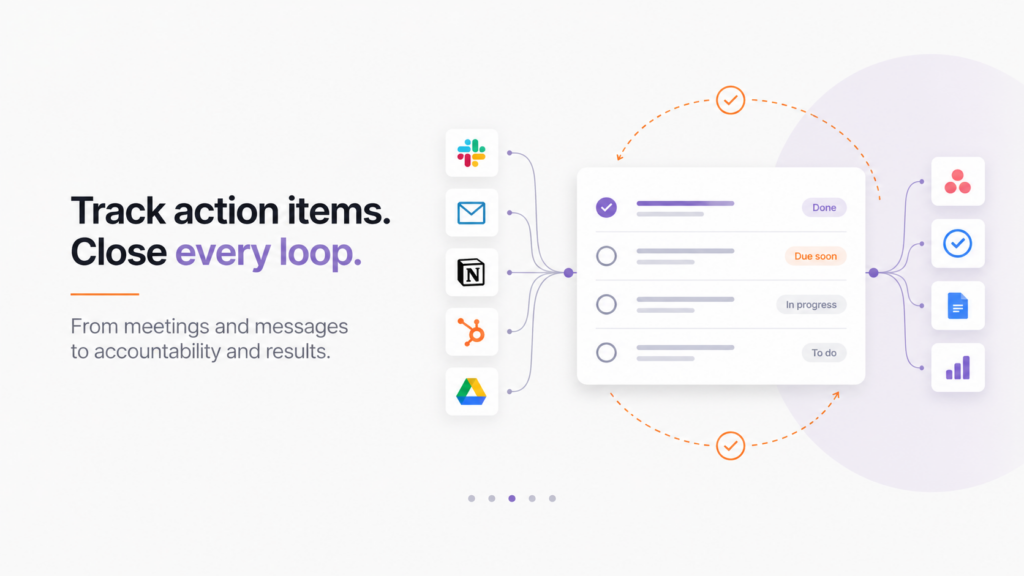
An AI task manager for meetings is a system that listens to or reads meeting content — transcripts, notes, recorded calls, calendar-linked documents — and automatically extracts, structures, and assigns the action items that were discussed.
The key word is automatically. The moment you require a human to manually review an AI’s suggestions and decide which ones to turn into tasks, you reintroduce the friction that caused the problem in the first place. A meeting has just ended. The next one starts in ten minutes. Nobody is going through a list of “potential action items” and carefully assigning owners.
A genuine AI task manager does this work without waiting for a human to prompt it. It captures the output, structures it, assigns ownership, and begins tracking — all before the meeting participants have even opened their laptops again.
The Wincent Approach: Meeting Output as Operational Input
Wincent treats meeting outputs not as documentation but as operational inputs. When a decision is made in a Teams call or a Google Meet session, that decision immediately enters Wincent’s processing pipeline — moving from capture through judgement to execution without manual intervention.
This works across the full breadth of meeting formats: structured project check-ins, informal strategy conversations, one-on-ones, and client calls. Wincent does not require meetings to follow a particular format or use specific language. It applies AI judgement to recognize commitments in context, which is a considerably harder and more valuable capability than keyword matching.

Integration: Where Meetings Live, Wincent Listens
One of the practical challenges of meeting-to-task systems is that meetings do not all happen in the same place. Some teams run primarily on Microsoft Teams; others live in Google Meet; others use Zoom. And the commitments made in those meetings often reference work tracked in Notion, HubSpot, or Slack.
Wincent’s integration with Microsoft 365, Google Workspace, Slack, Notion, and HubSpot means it can operate across this fragmented landscape. It does not require all meetings to happen in one place or all tasks to live in one system. It connects the dots between where decisions are made and where work gets done.
The Cost of Dropped Action Items
Dropped action items are not just inefficient — they are expensive. When a commitment made in a client meeting goes untracked, it risks a relationship. When a product decision made in a leadership call never gets implemented, it delays a roadmap. When a compliance action item from a risk review gets lost, it creates liability.
These are not hypothetical risks. They are the daily operational reality of teams that rely on human memory and informal coordination to close the gap between meeting and action. The compounding cost is rarely visible in any single incident — but over months and years, it is substantial.
Conclusion
Meetings will always be the place where teams make their most important decisions. The question is whether those decisions reliably become action — or whether they disappear into the gap between intention and execution.
An AI task manager for meetings, built on the architecture that Wincent represents, makes the reliable conversion of decisions into actions a structural guarantee rather than an individual effort. Stop dropping action items by stopping the reliance on human memory to catch them.