When people hear “AI team coordinator,” they usually think of scheduling assistants and automated meeting notes. These are useful capabilities. They are also the shallow end of what coordination actually requires — and they leave the hard part entirely to humans.
Real team coordination is not about finding a meeting time or summarizing what was said. It is about ensuring that the decisions made in that meeting reliably become action, that the right people owcoordination of a team
n the right work, that progress is tracked, and that blockers are surfaced before they become crises. This is the work th at falls apart in most organizations — and it is the work that a genuine AI team coordinator should be doing.

The Coordination Problem Modern Teams Actually Have
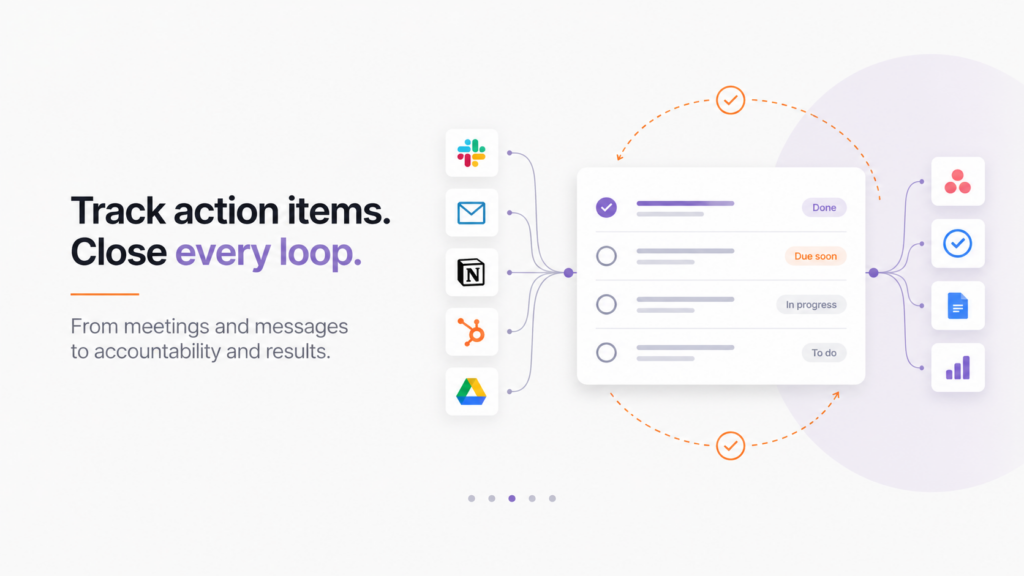
Modern teams are distributed across tools, time zones, and communication styles. A decision made in a Slack thread needs to be connected to a task in Notion. A commitment made in a sales call needs to trigger follow-up in HubSpot. A strategy discussed in a leadership meeting needs to cascade into execution across multiple functions.
Human coordinators — project managers, operations leads, Chiefs of Staff — spend enormous amounts of time manually bridging these gaps. Reading across systems. Translating decisions into tasks. Chasing status. Running coordination meetings whose primary purpose is to surface information that should already be visible. This is high-value work when done well, but it is also expensive, bottleneck-prone, and almost impossible to scale.
What AI Changes About Coordination
AI changes coordination not by eliminating the coordination function but by automating the most mechanical and time-consuming parts of it. Reading meeting outputs and extracting action items. Assigning those items to the right owners based on context. Tracking progress and generating follow-up without human prompting. Surfacing patterns that indicate systemic coordination problems rather than individual failures.
When these functions are automated, human coordinators can focus on the genuinely high-judgment work: resolving conflicts, managing stakeholder relationships, making strategic calls about prioritization. The cognitive overhead of tracking and chasing shrinks. The strategic value of the coordination function grows.
Wincent as Cross-Stack Coordinator
Wincent (wincent.ai) is designed as a coordination layer that operates across the full complexity of how modern teams work. Its integrations with Microsoft 365, Google Workspace, Slack, Notion, and HubSpot mean it can read context from wherever work happens — not just from one designated system.
This cross-stack visibility is what makes Wincent a genuine coordinator rather than a single-tool add-on. A tool that only reads from Notion misses everything that happens in Slack. A tool that only reads meeting transcripts misses the follow-up that happens in email. Wincent sees the full picture — and because it sees the full picture, it can coordinate across it effectively.
The Four Coordination Functions Wincent Handles
Wincent’s coordination work maps to four functions that human coordinators currently own. First, capturing decisions from wherever they are made — meetings, messages, documents — and converting them into structured operational data. Second, assigning work to the right owners with appropriate deadlines and context. Third, tracking progress proactively and surfacing stalling items before they become problems. Fourth, identifying patterns across coordination data to flag systemic bottlenecks and improvement opportunities.
Each of these functions is handled automatically, at the speed of the work itself — not at the speed of a weekly coordination call or a monthly retrospective.
Conclusion
An AI team coordinator that only handles scheduling and notes is solving a small problem while leaving the large one untouched. Real coordination — the kind that determines whether decisions become outcomes — requires visibility across the full operational stack, intelligent assignment, and proactive follow-through.
Wincent is built to be this kind of coordinator: one that goes well beyond scheduling and notes to actually close the loop between what teams decide and what they deliver.