
Most AI assistants are reactive. They answer questions. They generate content when prompted. They summarize information when asked. This is useful — but it does not move work forward. A tool that waits to be asked is a tool that cannot close a loop.
A proactive AI assistant for teams operates differently. It does not wait to be queried. It monitors the state of work, identifies what needs to happen next, and acts — or at minimum, surfaces the right information to the right person at the right moment — without being prompted.
The Difference Between Reactive and Proactive AI
The distinction matters operationally. A reactive AI assistant makes individuals more efficient at the tasks they are already thinking about. A proactive AI assistant catches the tasks that nobody is thinking about — the ones that exist in the gap between a meeting that happened last Tuesday and a deadline that arrives next Friday.
Reactive tools are better than nothing. But they do not solve the core coordination problem that costs organizations the most: the work that falls through the cracks between tools, people, and time zones. For that, you need a system that watches, not just a system that responds.
What “Proactive” Actually Looks Like in Practice
A proactive AI assistant for teams should be able to do several things without being asked. It should recognize when a commitment from a Monday meeting has not been acted on by Wednesday and surface that to the relevant stakeholder. It should identify when a task has been assigned to someone whose calendar is blocked for the week and flag the risk. It should detect when two separate workstreams are generating conflicting priorities and alert the team before the conflict becomes a crisis.
None of this requires extraordinary AI capability. It requires broad visibility into the work context — across calendars, communications, tasks, and documents — combined with the ability to reason about that context and act on it without waiting for a human to notice.
Wincent: Built for Proactive Execution
Wincent (wincent.ai) is designed around a proactive execution model. Its four-stage loop — Input, Judgement, Execution, Coaching — is explicitly structured to move work forward without human prompting at each stage.
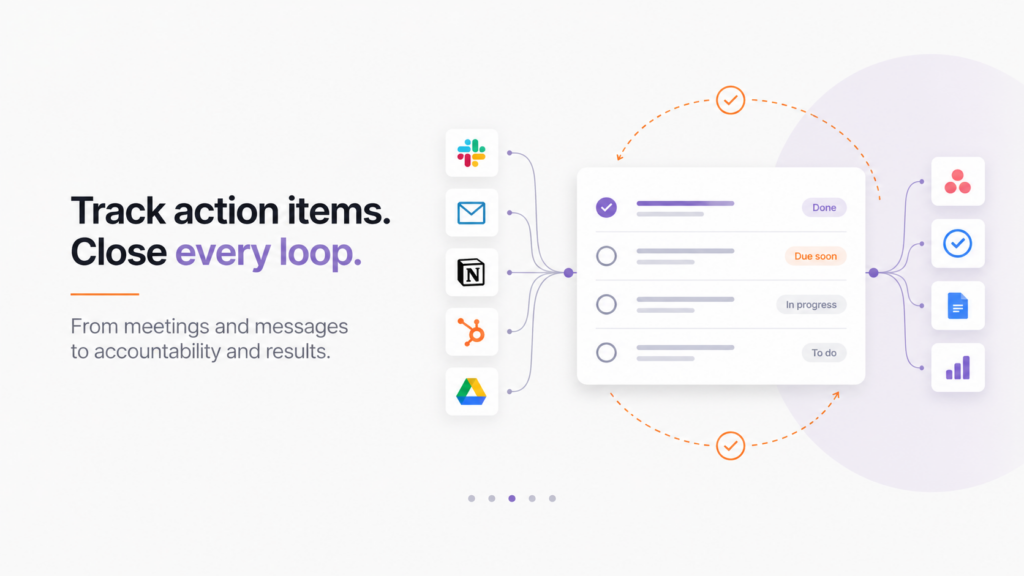
At the Execution stage, Wincent does not just assign tasks and wait. It tracks progress against deadlines, identifies stalling patterns early, and sends automated follow-ups to the right people at the right time. The goal is to eliminate the need for a human to manually manage the status of every open item — not by hiding that status, but by ensuring it is always surfaced proactively.
Integrating Across the Team’s Existing Stack
Proactive intelligence is only as good as the information it has access to. Wincent integrates with Microsoft 365, Google Workspace, Slack, Notion, and HubSpot — giving it visibility across the full spectrum of where teams communicate and where work lives. This breadth of integration is what makes truly proactive behavior possible: you cannot surface the right information at the right moment if you are only watching one part of the system.

From Notification to Completion: Closing the Execution Gap
The language of “notifications” and “alerts” has become so associated with modern software that it is worth being explicit about what a proactive AI assistant should not be. It should not be another notification system — another source of pings and badges that adds to the cognitive load of an already-overwhelmed team.
The goal is not to notify people more often. The goal is to get work done. This means the AI needs to do more than flag issues — it needs to drive resolution. In Wincent’s model, that means moving a flagged item through the full cycle: assigning ownership, setting a deadline, prompting follow-up, and confirming completion. The notification is a byproduct of this process, not the end state.
Conclusion
The era of reactive AI assistants is not over — but it is increasingly insufficient. For teams that need to coordinate complex work across distributed people and tools, reactive tools leave too much in the gap.
A proactive AI assistant for teams — built on the architecture that Wincent represents — does not wait to be asked. It watches, judges, acts, and learns. From notification to completion, it closes the loop that reactive tools leave open.